


[A REVISAR] How to assess the real acoustic performance of a design acoustic ceiling: a practical guide for architects
More and more projects are incorporating design acoustic ceilings to improve acoustic comfort. However, many of these systems do not deliver the expected performance. The mistake usually lies in assuming that a “soft”, “textile” or “porous” material is automatically acoustic.
That is not the case. A system can be attractive and still change nothing in the acoustic behaviour of the space. That is why, before specifying a solution, it is worth knowing which parameters matter and how to interpret them. This article explains clearly how to assess the real performance of a design acoustic ceiling in order to avoid false expectations and choose solutions that genuinely work.
Introduction: when aesthetics are not enough to improve acoustics
The importance of data: why a decorative system is not always acoustic
Contemporary architecture tends to use clean surfaces, continuous materials and large hard planes. When an acoustic problem arises, the reaction is usually to add “something that absorbs”.
But absorption does not depend on appearance; it depends on the internal structure of the material and its behaviour as measured in the laboratory. A material may seem highly absorbent because of its feel or texture, yet deliver minimal performance if it has not been designed for that purpose. Assessing it rigorously means understanding two key concepts: the weighted sound absorption coefficient αw and the frequency absorption curve.
The absorption curve: where you really understand whether the system works
The αw is an overall indicator, but it does not tell the whole story. A professional assessment requires looking at the absorption curve, which shows how the system behaves at different frequencies.
In offices, classrooms or restaurants, the most important range is the speech range (500–2000 Hz). That is where an acoustic ceiling must absorb. Some materials show high absorption peaks at high frequencies, which flatters the overall result, but absorb very little at mid frequencies.
In practice, this results in spaces that still sound “harsh” despite having incorporated these solutions. A PET acoustic ceiling with balanced density, such as those used by Deco Acoustic, tends to offer more stable curves in that mid range, which translates into a noticeable improvement in speech intelligibility.

Installation: the second factor that determines performance
Two identical elements can behave very differently depending on how they are installed. It is an aspect that is often overlooked, but it is essential.
System installed on a vertical wall surface
It mainly absorbs high frequencies and some of the mid frequencies. It is the least efficient option at low frequencies.
System with an air cavity behind
Performance increases markedly, especially at low and mid frequencies. A gap of just a few centimetres is enough to notice the difference.
Tile integrated into an accessible ceiling
It usually offers uniform and predictable absorption, especially if the plenum has a certain depth.
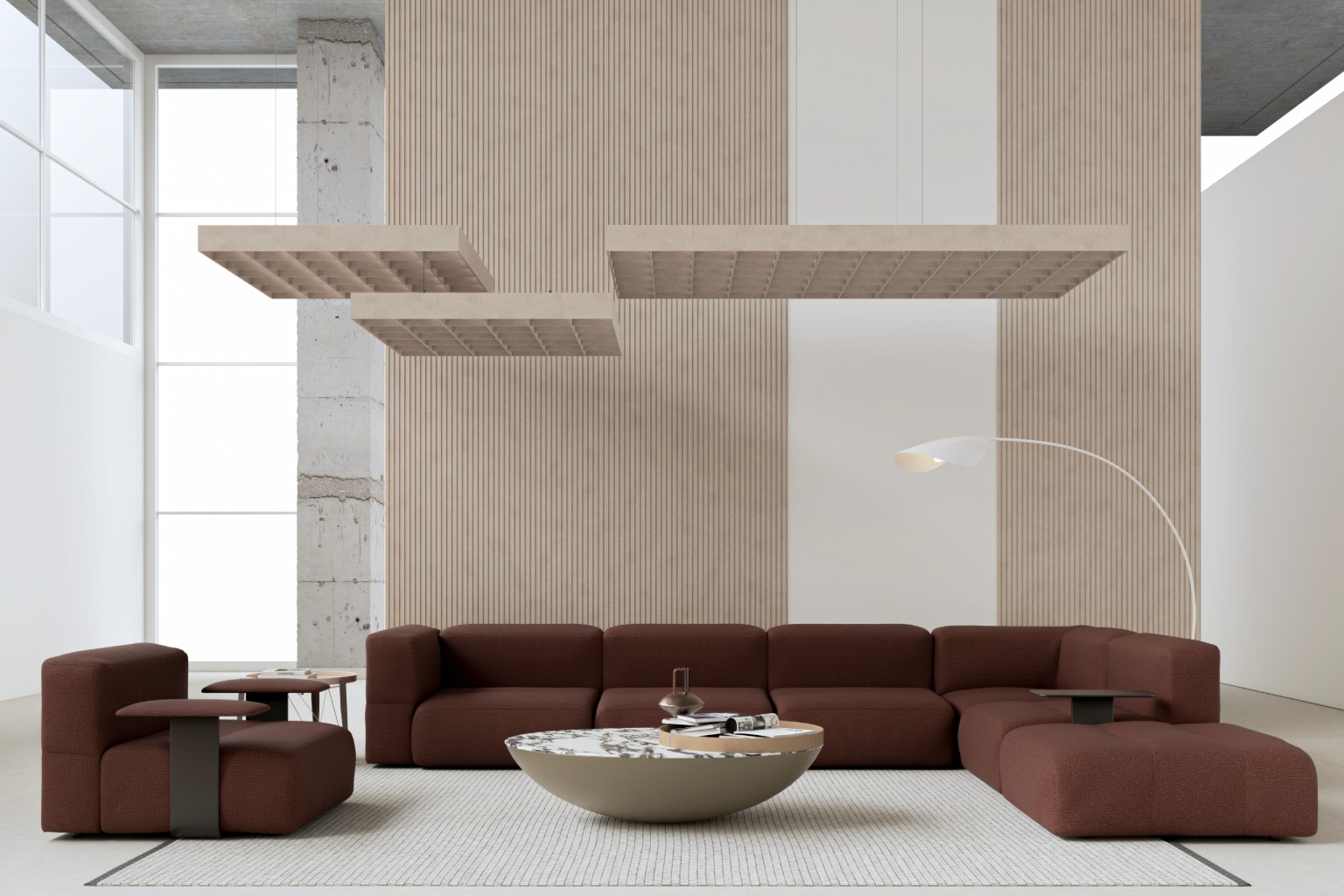
Element suspended as an island
It absorbs on both faces, which improves performance per m². Ideal when you do not want to cover the entire ceiling.
For this reason, a good manufacturer always specifies the mounting type for which the system has been tested. Without that information, the acoustic value cannot be compared.
Density, thickness and material: how they really influence performance
Acoustic performance is explained by the interaction between: thickness density porous structure and stiffness of the material
A very thick but rigid material may absorb less than a thinner one with the right density. What matters is not whether the finish looks absorbent, but how the material behaves internally. In PET, the heat-bonded fibre structure creates a very controlled porosity, which is why its performance is stable even though the element is lightweight. The 9 mm and 24 mm thicknesses cover different acoustic requirements without adding excessive weight.
How to compare acoustic systems to make informed decisions
An architect assessing acoustic ceilings should always ask this question: what data does the manufacturer provide and what can I verify? A useful comparison is based on four elements:
Complete acoustic test
If there is no UNE-EN ISO 354 test, there is no guarantee.
Test conditions
Mounting type, thickness tested, air cavity, position.
Absorption curve
Key to knowing whether the solution will improve speech intelligibility.
Material behaviour
Density, porosity, dimensional stability, fire resistance.
When this data is clear, choosing is straightforward; when it is missing, there is a risk of investing in a purely decorative system
How to tell whether an acoustic ceiling has been well selected
A system chosen with sound judgement changes not only the sound, but the way the space is experienced. The effects are immediate: the sensation of echo decreases voices are understood better conversations stop carrying and the atmosphere feels calmer
It is not a subtle improvement; it is a sensory change that redefines the atmosphere of the place.
An acoustic ceiling is chosen with data, not intuition
Aesthetics remain important, but they must never replace technical information. A decorative element can contribute to the atmosphere, but if it is meant to improve acoustics, it has to prove it with tests, absorption curves and precise specifications. When it is assessed correctly, and a system designed to deliver real performance is chosen, such as PET acoustic ceilings with high absorption values, the effect on the space is consistent and measurable.
Acoustics are not an add-on. They are part of the architecture. And as such, they deserve a decision based on data, not appearances.
Access the Deco Acoustic technical documentation and choose acoustic ceilings based on real performance.
This article is for information purposes only and is based on the information available at the date of publication. Owing to the constant evolution of technology, regulations and technical specifications, some of its content may become outdated or be modified over time. In the event of any discrepancy, the manufacturer’s or supplier’s current official technical documentation shall always prevail. For any queries, or if you need advice applied to a specific project, please do not hesitate to contact our team.

Write a Comment
You must be logged in to post a comment.