


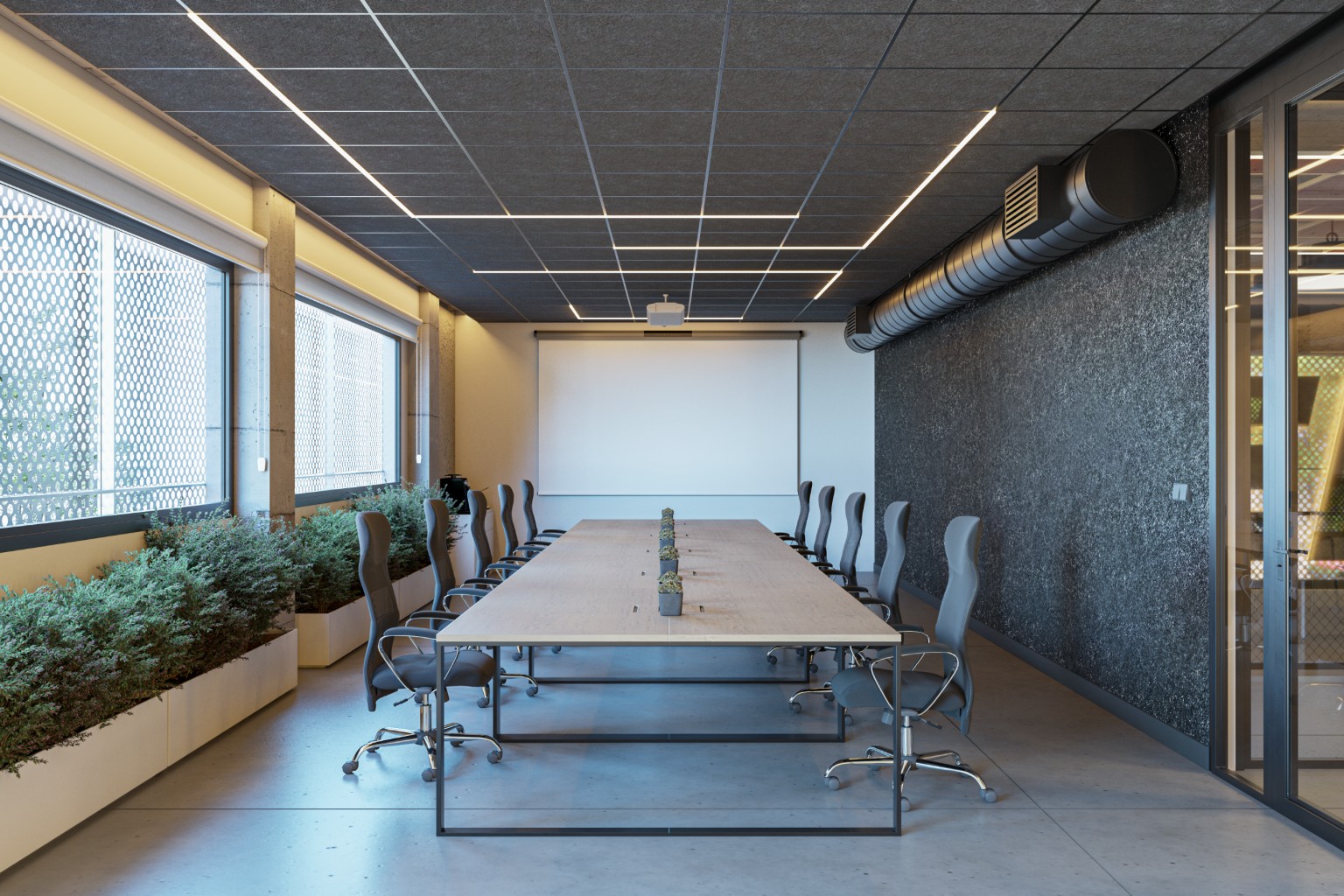
How to improve acoustics in a refurbishment without building works: real strategies with PET design acoustic ceilings
In interior refurbishments, acoustics often come into play late in the process. The project moves forward and the space is visually renewed, but at the end —when everything seems settled— the problem emerges: the echo persists, voices bounce around and the room sounds “harsher” than expected.
When the space is already built, but the sound does not work
There is often no scope to dismantle the ceiling, reconfigure building services or carry out works that would mean closing the space.
This is where Deco Acoustic design acoustic ceilings made from PET become a particularly valuable tool: they make it possible to intervene without building works, without altering the original architecture and with an audible improvement from day one.
Why so many refurbished spaces still sound bad
Many existing interiors —older offices, converted retail units, restaurants, traditional classrooms— share the same problem: they were designed with layout or aesthetics in mind, but not acoustic performance.
The result is usually a collection of reflective surfaces: hard ceilings, bare walls, continuous flooring and rigid furniture.
Even if the space changes visually, the sound keeps striking the same planes.
Correcting this does not require transforming the space, but rather introducing absorbent materials where the sound needs them most.
The key in refurbishment is not to intervene a lot, but to intervene well
When building works are not possible, acoustics become a strategic matter: identifying which surfaces generate the reverberation and acting precisely at those points.
And here PET acoustic elements offer a clear advantage: they are lightweight, easy to install and, in some cases, require nothing to be dismantled.
They also work both vertically and horizontally, which means they can be adapted to the specific circumstances of each refurbishment.
This opens the door to solutions that significantly reduce installation time.
Acoustic islands: intervening from the ceiling without touching it
In spaces where the existing ceiling cannot be altered —because it houses building services, because it is heritage-listed or because it has just been refurbished— acoustic islands have become one of the most effective answers.
A suspended island acts as an absorber on both faces, so it treats the sound without needing to cover the entire surface.
In a room with high reverberation, a few strategically distributed islands make it possible to:
- soften the overall echo
- reduce the sound level during conversation
- and improve comfort without introducing an intrusive visual element
The PET version of the acoustic islands stands out for its lightness, which simplifies installation and avoids placing stress on the slab or auxiliary structures.
Vertical panels: correcting the sound from the walls
When the ceiling cannot be touched at all —or is simply not the surface contributing most to the problem— vertical panels become the best tool.
Placed on the right wall —usually the surface that directly reflects the voice— they make it possible to:
- reduce immediate echo
- improve clarity in meeting rooms or classrooms
- and soften the sense of harshness in the space
Here PET brings a significant aesthetic advantage.
Its matt texture, surface continuity and wide colour range allow an absorbent panel to become a decorative feature with no need to conceal it.
In refurbishment, where every decision must blend with what already exists, this balance between function and design matters more than ever.
Light renovation of the accessible ceiling: when the problem lies in the tiles, not the structure
Many buildings have modular ceilings that work correctly from a technical point of view (building services, access, heights), but provide no real absorption.
In these cases, replacing only the visible tiles with Grid-type PET acoustic ceilings transforms the acoustics without touching the suspension grid or the building services. The Deco Acoustic Grid system is compatible with T15 and T24 metal suspension grids.
This type of intervention is especially useful in occupied offices, coworking spaces, clinics or classrooms where the space cannot be closed for works.
The resulting absorption depends on the format of the element, its thickness and the existing plenum, but the perceptible improvement is immediate.
How to decide where to place the elements without a complex study
In refurbishment, there are three simple —but very precise— criteria that help decide where to install the solutions:
- Points of direct reflection
These are the surfaces where the voice bounces before reaching the listener. Normally a smooth wall or a very low ceiling. - Areas of heaviest use
Spaces where conversations take place constantly: bar counters, waiting areas, small rooms, meeting tables. - Facing surfaces
When two parallel planes amplify the echo, treating just one of them is enough to break the “sound box” effect.
PET works particularly well in any of these configurations, because it combines real absorption with extremely simple installation.
Why Deco Acoustic acoustic systems are the most suitable for interventions without building works
These sound-absorbing systems offer several advantages that make them almost irreplaceable in refurbishment:
- Lightness: they avoid additional loads and make for quick installation.
- Dimensional stability: the element does not bow or deform over time.
- Visible finish: they need no fabrics, veils or additional coverings.
- Durability: they do not shed fibres or require sophisticated maintenance.
- Measured performance: certified sound absorption tests to UNE-EN ISO 354.
- Compatibility with any aesthetic: from minimalist interiors to warm or heritage spaces.
In refurbishments, where the intervention must respect what already exists, this balance between technical function and formal discretion is essential.
What changes in the user experience
The most interesting thing about an acoustic intervention without building works is that the impact is felt immediately.
The place does not “look altered”, but it feels different.
- Conversation becomes easier to understand.
- The room no longer sounds metallic or empty.
- The space acquires a sense of calm that is hard to explain, but obvious.
- The room becomes a place where people want to stay, not just pass through.
Interior architecture is also built with sound, and a well-executed refurbishment proves it without the need for major transformations.
Transforming the sound without transforming the space
Deco Acoustic design acoustic ceilings in PET offer a precise answer to a very common problem: improving acoustics when there is no scope for invasive works.
They make it possible to act where it matters, quickly, cleanly and leaving the existing architecture intact.
They are a design tool, not a patch; a solution that improves the way the space is experienced and heard.
Refurbishment does not always need more building work. Sometimes, it just needs better acoustics.
Download the technical catalogue and discover how to apply design acoustic ceilings in refurbishments without building works, with immediate and measurable results.
This article is for information purposes only and is based on the information available at the date of publication. Owing to the constant evolution of technology, regulations and technical specifications, some of its content may become outdated or be modified over time. In the event of any discrepancy, the manufacturer’s or supplier’s current official technical documentation shall always prevail. For any queries, or if you need advice applied to a specific project, please do not hesitate to contact our team.


Write a Comment
You must be logged in to post a comment.