



Sustainability and the circular economy in designer acoustic ceilings: why recycled PET is now a benchmark architectural material
Talking about sustainability in architecture no longer means adding a paragraph to the project report. It means making material decisions that back up the discourse. In acoustic treatment, this search for responsible materials has led recycled PET to become one of the most relevant solutions among designer acoustic ceilings.
Sustainability by design
Its combination of technical performance, aesthetics, safety, indoor health and circularity has led architecture practices, engineering firms and environmental consultancies to adopt it as a preferred option. This article explains why.
Recycled PET as an architectural material
PET (polyethylene terephthalate) is one of the most widely used polymers in the world. Its abundance makes it an ideal candidate for recovery processes. When it is transformed into non-woven felt, it acquires properties that are highly valuable for interior architecture: stability, durability, lightness and surprisingly good acoustic behaviour for such an easy-to-handle material.
In the Deco Acousticcollection, the element is made of 100% PET, with a minimum of 60% recycled content, heat-treated to ensure dimensional stability, low VOC emissions and a fire rating of B-s2,d0.
This in itself makes an important difference: this is a material whose sustainability is structural, not cosmetic.
Why it fits perfectly into the circular economy
Unlike other acoustic systems, recycled PET meets the three fundamental conditions of circularity:
It comes from an abundant and easily recoverable waste stream
Each piece helps to reduce the plastic waste footprint, transforming waste into a material with architectural value.
It is a single material and easy to recycle
Many traditional absorbers combine several layers (acoustic layer + finish + backing), which makes them difficult to recycle.
Deco Acoustic PET is a single piece: it can be reprocessed.
It retains its technical value throughout its service life
It does not degrade appreciably, does not shed fibres and does not require repainting or reinforcement. This means it reaches the end of its service life in optimum condition to be reintroduced into the cycle.
It is rare to find an interior design material that meets these three conditions simultaneously.
Acoustic performance: sustainability without sacrificing function
Recycled materials are often perceived as “eco” but not very technical. PET breaks this prejudice.
THU’s PET elements offer absorption values that can reach up to αw 0.90 (Class A) in 24 mm thicknesses according to UNE-EN ISO 354.
This means that a recycled material can absorb the same amount as, or more than, systems based on mineral wool, perforated panels or resonant cavities, but with a more pleasant aesthetic and a lower environmental impact.
This performance is no accident: the controlled thickness and the porous structure mean that PET absorbs in a balanced way across the speech range, which is essential in offices, restaurants and education.
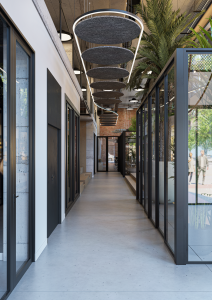
Environmental comparison with other acoustic absorbers
To understand the relevance of recycled PET, it is worth comparing it with common alternatives:
Mineral wool
It requires additional finishes and combines materials that make recycling difficult. It generates dust on site and does not always offer aesthetic stability without trims.
Perforated elements (wood or plaster)
They depend on lacquers, paints and perforations that complicate the separation of materials. Moreover, they provide no absorption on their own: they need mineral wool behind them.
Melamine or polyurethane foams
They are light and cheap, but they age less well, are more fragile and, in some cases, have less favourable fire behaviour.
By contrast, PET combines:
- single-material composition
- recyclability
- good fire behaviour
- a visible finish
- and measured acoustic performance
It is an equation that is hard to beat in projects that aim to reduce their impact while maintaining a refined aesthetic.
Certifications and wellbeing: how PET contributes to contemporary architecture
Today’s projects are no longer limited to complying with the Spanish Technical Building Code (CTE); they must demonstrate how they relate to wellbeing and sustainability certifications such as WELL, LEED or BREEAM.
Recycled PET contributes directly to these systems:
- Its low VOC content promotes indoor air quality.
- Its documented recycled content helps projects qualify for green financing.
- Its recyclability improves the circularity of the project.
- Its acoustic performance contributes to comfort criteria, which are essential in WELL.
It is one of the few acoustic treatment materials that scores in all the relevant categories: health, sustainability, circularity and performance.
Where recycled PET acoustic ceilings make the most sense
PET is particularly interesting in projects that combine design, sustainability and intensive use:
- corporate offices seeking healthy environments
- educational centres where air quality is key
- restaurant projects that need quick, clean solutions
- public buildings with strict environmental criteria
- refurbishments where interventions must be lightweight
- high-end housing with a sensitivity towards honest materials
Its versatility makes it a cross-cutting material.
A material of the present for the architecture of the future
Designer acoustic ceilings made from recycled PET are a clear example of how architecture can move forward: responsible materials, proven performance and contemporary aesthetics in a single solution.
Sustainability is not at odds with design, nor is circularity at odds with performance.
PET shows that a recycled material can be technical, beautiful and environmentally friendly at the same time.
Request the technical dossier and find out how to integrate recycled PET acoustic ceilings into projects where performance and sustainability must go hand in hand.
This article is for information purposes only and is based on the information available at the date of publication. Due to the constant evolution of technology, regulations and technical specifications, some of its content may become outdated or change over time. In the event of any discrepancy, the manufacturer’s or supplier’s current official technical documentation shall always prevail. For any queries, or if you need advice applied to a specific project, please do not hesitate to contact our team.


Write a Comment
You must be logged in to post a comment.