


How to improve acoustics without sacrificing aesthetics: the role of PET in design acoustic ceilings
In any contemporary project, the acoustic quality of a space is as decisive as its lighting or its layout. For a long time, however, acoustics were addressed with materials that interrupted the language of the project: perforated elements that imposed their own visual logic, foams that aged badly, and solutions more reminiscent of an industrial space than of a designed interior.
The need to unite aesthetics and sound in interior architecture
The arrival of recycled PET in acoustic systems has made it possible to rethink this relationship. It has given rise to a distinct category: design acoustic ceilings, absorbers that perform their technical function without betraying the aesthetics of the space. And they do so with measurable values, not vague promises.
PET as a material: why it works in acoustics and in design
The PET used in design acoustic ceilings is made from non-woven fibres compacted to form a rigid, porous structure. That porosity is not random: it is controlled so that sound penetrates between the fibres and dissipates as heat, reducing reverberation.
In THU’s Deco Acoustic collection, this structure undergoes a heat treatment that stabilises the fibres and produces an acoustic element with:
- a thickness of between 9 and 24 mm
- low VOC content and REACH compliance
- a composition of 100% PET (min. 60% recycled)
- measured acoustic performance of up to αw 0.90 (Class A) in 24 mm thick elements
This combination of properties explains why PET is a mature and efficient alternative to traditional materials.
How a PET element actually absorbs sound
Although it may seem simple, an acoustic element works through a complex process. Sound enters the element, travels between the fibres and loses energy through friction. The more controlled the structure, the more balanced the absorption across different frequencies.
This is the real advantage of PET over purely decorative elements: its performance is predictable, stable and verifiable.
In spaces such as offices, restaurants or classrooms, where the voice is the main sound source, this balanced absorption in the speech range (500–2000 Hz) is key. Without it, the space still sounds “harsh” even if there are acoustic elements on the walls.
Aesthetic advantages: when acoustics are no longer perceived as a technical add-on
One of the reasons why PET acoustic ceilings have become so widespread is their ability to blend into the architecture without standing out as a technical element.
Unlike perforated systems, which force the design to embrace a visual pattern imposed by the perforation, PET offers a uniform, warm, matt textile surface.
This allows the element to:
- preserve visual continuity,
- soften light without glare,
- blend into carefully designed spaces,
- add texture without being intrusive.
The colour palette available in Deco Acoustic, from neutrals to saturated tones, extends this integration even further.
It is not a material that has to be concealed: it is one more element of the project, with an identity of its own.
How PET compares with other acoustic materials
Compared with mineral wool
Mineral wool needs an additional finish (fabric, perforation, board), which adds complexity and limits the aesthetics. PET provides finish and absorption in a single piece.
Compared with perforated elements
These systems depend on a visible geometric pattern. PET makes it possible to work with clean surfaces without the technical look of perforation.
Compared with decorative acoustic foams
Foams tend to age less well, are more fragile and do not always provide values measured to UNE-EN ISO 354. PET offers stability, durability and verifiable test results.
Compared with high-density sound-absorbing materials
PET is much lighter, which makes it easier to install in refurbishment projects or on ceilings with limited load capacity.
This comparison explains why design acoustic ceilings based on PET have become the choice of architecture and interior design studios.
Formats that expand design without compromising acoustics
THU’s Deco Acoustic PET collection makes it possible to adopt multiple geometries without sacrificing performance:
Linear surfaces (Linear)
They create continuity and visual rhythm, softening reverberation without producing a ceiling that looks noticeably technical.
Grid-type modulation
Ideal for renovating accessible ceilings. It maintains accessibility and brings a more contemporary aesthetic.
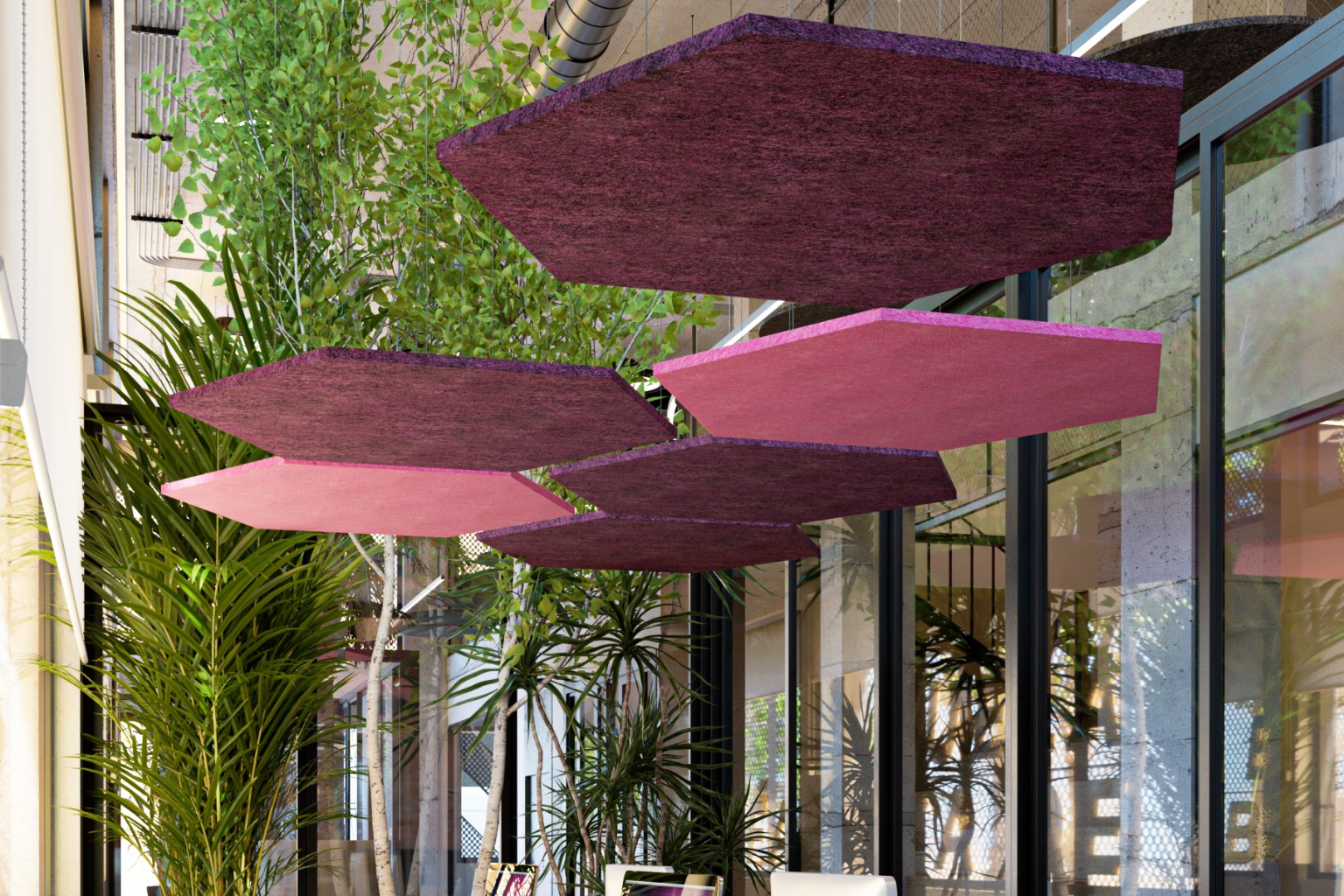
Acoustic islands
Perfect for intervening without building work. They are installed suspended and absorb on both faces, which makes them effective even with high ceilings or in large-volume spaces.
Vertical panels
Very useful in meeting rooms or in spaces where the ceiling cannot be touched or where the treatment has to extend to the vertical plane. As well as absorbing sound, they bring visual order to the wall.
Each of these formats responds to a different need, allowing the acoustics to be adapted to the language of the project, not the other way round.
Where design acoustic ceilings in PET make most sense
Open-plan offices
PET makes it possible to treat critical areas without disrupting the reading of the space. Combining an absorbent ceiling with vertical panels improves speech intelligibility and privacy.
Hospitality
Its controlled aesthetics avoid the “technical ceiling” effect in restaurants, cafés and bars, where atmosphere is key.
Educational spaces
The stable performance of PET helps to control voices and reduces acoustic fatigue, which is essential in classrooms and libraries.
Retail
When exposed services and ceiling heights complicate acoustic treatment, PET islands make it possible to intervene without altering the architecture.
High-end housing
Here, a sense of visual warmth comes first. The textile finish and clean geometries of PET blend in naturally.
Sustainability: one more layer of consistency
Recycled PET not only improves acoustics and aesthetics; it is also aligned with genuine environmental strategies.
Its recycled content (min. 60%), its low VOC emissions and its recyclability make it a material consistent with certifications such as LEED, BREEAM or WELL.
In the Deco Acoustic range, this commitment is also part of the Kingspan Group’s Planet Passionate strategy, which aims to minimise impact and promote circular models.
The result is an acoustic solution that not only works but also fits the values expected of today’s architecture.
Acoustics and design no longer follow separate paths
Design acoustic ceilings in PET allow acoustic correction to become part of the architectural language of the project.
Their absorption capacity, lightness, stability and contemporary aesthetics have placed them at the centre of today’s interior architecture.
With PET, acoustics are no longer a concession but an opportunity: a tool for creating spaces that look good, feel good and, above all, sound good.
Find out more about the Deco Acoustic acoustic ceiling system. Download the catalogue now.
This article is for information purposes only and is based on the information available at the date of publication. Owing to the constant evolution of technology, regulations and technical specifications, some of its content may become outdated or change over time. In the event of any discrepancy, the manufacturer’s or supplier’s current official technical documentation shall always prevail. If you have any questions or need advice for a specific project, please do not hesitate to contact our team.

Write a Comment
You must be logged in to post a comment.