



Designer acoustic ceilings: a clear, practical guide to what they really bring to architecture
Designer acoustic ceilings have become a common feature of interior architecture projects. Not only because they help to control reverberation, but because they make it possible to address acoustics in a way that fits the contemporary visual language: clean surfaces, precise geometries, carefully chosen colours and materials that convey warmth.
For years, solving acoustics meant choosing between two options: either highly technical ceiling systems, which often meant sacrificing aesthetics, or solutions that delivered little real performance. Today the picture is different. Materials such as recycled PET have made it possible to develop systems that combine high-level acoustic performance with aesthetic value and the potential to elevate the architectural project.
THU’s Deco Acoustic collection is a good example. Its acoustic ceiling solutions are made from PET felt with a minimum of 60% recycled content, and the base material offers sound absorption of up to αw 0.90 (Class A) and a fire rating of B-s2, d0 (and even B-s1-d0 on request, in certain colours). These figures are not incidental: they reflect a change in how acoustics are understood in architecture. It is no longer just a matter of “installing absorbers”, but of integrating solutions that are consistent with the design, the regulations and sustainability.

What we mean today by “designer acoustic ceilings”
The term has gained prominence, but it is worth defining it properly. A designer acoustic ceiling system is an element that absorbs sound, yes, but that also fulfils an aesthetic function. In other words, it is not meant to go unnoticed, but to form part of the architecture.
This implies three essential characteristics:
- Real acoustic performance, measured with verifiable data.
- Carefully considered materiality: texture, colour, geometries.
- The ability to integrate into different formal languages, from corporate to educational, retail or residential.
The key is that the acoustic solution does not disrupt the space, but completes it.
How they work and why the material matters
In PET acoustic ceilings, absorption occurs when sound passes through the fibre matrix and part of that energy is dissipated through internal friction. The more balanced the density, the more effective the material is in critical frequency ranges.
Thickness also plays a role: the 9 mm typical of ceiling systems and the 24 mm of some islands or vertical elements serve to meet different absorption requirements.
In practical terms, the result can be summarised as:
- Better-controlled reverberation time
- Improved speech intelligibility in classrooms or meeting rooms
- Reduced ambient noise in restaurants or open-plan offices
But the material also shapes the aesthetics. The textile finish of PET provides great visual warmth and a continuous texture, while maintaining a clean, contemporary look.
Typologies: when acoustics respond to the intent of the project
Among designer acoustic ceilings, not all solutions are the same. The Deco Acoustic collection organises its systems into four families that cover virtually any project scenario.
| Typology | Recommended application |
|---|---|
| Linear | Continuous linear slats that bring rhythm and directionality. They work well when the aim is to emphasise a geometry or visually reduce the scale of a space. |
| Grid | The classic 595–600 mm format reinterpreted in PET. A particularly useful option for renovating existing accessible ceilings without altering the original structure. |
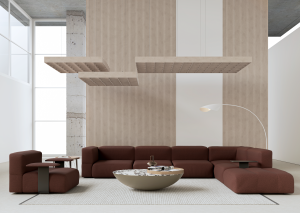
| Island | Suspended islands that absorb sound on both faces. Of interest in spaces with a large clear height or in projects where the aim is not to cover the entire ceiling. |
| Panel | Continuous systems with or without relief (Line, Dot, Waves). The most decorative version and the most flexible for treating walls and closed ceilings. |
Each one provides a different solution, but all of them maintain material and colour consistency.
How to choose designer acoustic ceilings according to the type of project
There is no single solution that is valid for everything. What matters is understanding what the space needs.
- Offices: Open-plan areas require large absorbent surfaces; meeting rooms need improved speech intelligibility. Linear or Grid on the ceiling, combined with vertical elements, is usually an effective response.
- Education: The reverberation values required by regulations make it necessary to act on both the ceiling and the walls. Here, Panel or Grid work particularly well.
- Hospitality and restaurants: The aim is not only to reduce noise, but to maintain a warm atmosphere. Island makes it possible to intervene without covering the whole surface and adds a refined visual presence.
- Retail: Construction time is critical. A lightweight, easy-to-install and customisable system such as PET acoustic ceilings saves time without sacrificing a clean design.
- High-end housing: Here, the priority is a sense of comfort and aesthetic consistency. Linear slats and decorative reliefs make it possible to solve acoustics with a highly integrated presence.
Compare to decide better
When acoustic options are evaluated, it is common to compare PET, perforated ceilings and mineral wool. Each system has its place, but PET offers a combination that is hard to match: good absorption, neutral aesthetics, low weight, dimensional stability and real customisation options.
Whereas perforated ceilings depend visually on the perforation itself and mineral wool always requires an additional finish, PET offers a complete solution in a single piece.
Frequently asked questions from architecture practices
Are designer acoustic ceilings enough to comply with regulations?
Do they affect building maintenance?
How do PET acoustic ceilings age?
Are they suitable for projects with environmental criteria?
An architectural tool, not just an absorber
Today’s architecture demands solutions that meet technical criteria but also respect aesthetic intent. Designer acoustic ceilings make it possible to work with colour, light, texture and rhythm without giving up acoustic control.
The Deco Acoustic collection shows that a recycled material can deliver professional-level performance (up to Class A (αw 0.90), B-s2,d0, low VOC, 100% recyclable) and, at the same time, integrate naturally into the space.
Ultimately, they are neither “decorative ceilings” nor “technical absorbers”: they are a tool that helps spaces work better and feel better.
This article is for information purposes only and is based on the information available at the date of publication. Due to the constant evolution of technology, regulations and technical specifications, some of its content may become outdated or change over time. In the event of any discrepancy, the manufacturer’s or supplier’s current official technical documentation shall always prevail. For any queries, or if you need advice applied to a specific project, please do not hesitate to contact our team.

Write a Comment
You must be logged in to post a comment.